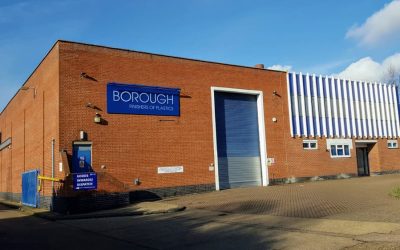
When your roof needs upgrading and you’re running energy-intensive manufacturing processes, you’ve got a simple choice: do the absolute minimum required, or think strategically about the next 20 years. Here at Borough, we chose the latter.
Our Leigh-on-Sea facility has just completed a major infrastructure upgrade and the result is visible from half a mile away, almost 1000 solar panels covering the entirety of our large industrial roof, generating an estimated 405,000 kWh of renewable energy annually.
The numbers are impressive, especially the lifetime carbon savings of 2,287 tonnes of CO₂ equivalent. But for our customers and us, the strategic thinking behind our decision matters more than the bare statistics.
Why this matters for manufacturing
Chrome plating and plastic injection moulding are energy-intensive processes and despite our investment in the latest energy-saving plant, there’s no getting around that. But our customers in automotive and packaging aren’t just asking about price and delivery times anymore, they want to know about sustainability credentials, supply chain resilience and the long-term thinking of partners such as Borough.
When you’re specifying components or looking for UK manufacturing partners, you need suppliers who’ve invested in modern facilities that can support both today’s production demands and tomorrow’s environmental expectations.
A 20-year-old roof with temporary patches doesn’t send that message. However, a comprehensively upgraded facility with renewable energy generation demonstrates our commitment to manufacturing excellence and sustainable manufacturing processes.
Being based in Leigh-on-Sea gives us better solar generation potential than facilities further north. Essex gets more sunshine hours than the Midlands or North West, which translates directly into higher annual generation. The 294,840 kWh we can access onsite annually reflects that southern location advantage.
The excess generation feeds into the wider grid, contributing to the UK’s renewable energy infrastructure, so it’s not just about what happens inside our facility walls but the UK’s wider campaign to reach net-zero.
Strategic infrastructure thinking
This project wasn’t about chasing headlines or ticking ESG boxes. It was about recognising that our roof needed work and making sure that work positioned us for the next two decades of manufacturing in the UK.
Modern facilities matter. Energy resilience matters. Demonstrable environmental commitment matters. Not because it’s fashionable, but because it’s what serious manufacturing customers expect from their supply chain partners.
When automotive manufacturers or drinks packaging businesses are seeking shorter, more reliable UK supply chains, they’re weighing multiple factors. Technical capability, obviously. Quality and delivery performance, certainly. But also: which suppliers are thinking long-term? Which ones have modern infrastructure? Which ones can credibly talk about sustainability without just pointing at a PDF policy document?
What comes next?
The installation is complete and our roof is now future-proofed. And although the renewable generation is online, this isn’t the endpoint of our facility investment, it’s part of an ongoing commitment to operational excellence and increased sustainability.
Because in UK manufacturing, you’re either thinking strategically about your infrastructure, your capabilities and your environmental performance, or you’re reacting to problems as they emerge. We know which approach builds better long-term partnerships with customers and this solar roof is just the latest step in our journey to more modern manufacturing.
The solar panels are visible from the road and the air, but what matters more is what they represent: a business investing in modern facilities, enabling renewable energy and taking the long view on manufacturing in the UK.